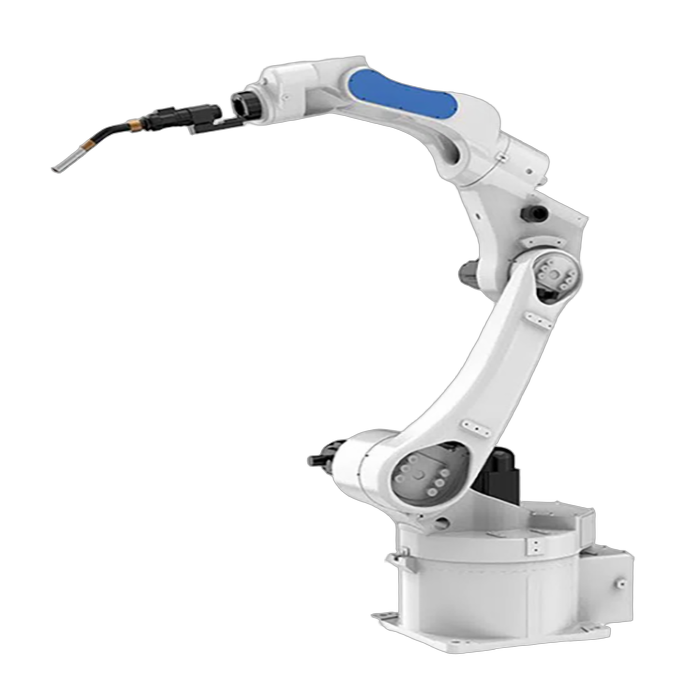

Key takeaways
- Price gap: Robotic welders start at $80,000-$120,000 for a full cell; cobot welders start at $40,000-$70,000 for a complete system including fixturing.
- Throughput difference: Robotic welders operate at 1,000-2,500 mm/min travel speed with 95%+ arc-on time; cobot welders run at 300-800 mm/min with 60-80% arc-on time.
- Decision shortcut: If your operation welds 50+ identical parts per shift on mild steel, choose a robotic welder. If batch sizes are under 20 and changeovers happen daily, a cobot welder delivers faster ROI.
- Safety model: Robotic welders require full safety fencing, light curtains and interlocked access gates. Cobot welders operate alongside workers with force-limited arms under ISO 15066.
- Programming time: Robotic welders need 2-8 hours per new part via teach pendant or offline CAD. Cobot welders can be programmed in 15-60 minutes via tablet-based hand guiding.
- Floor space: A robotic cell needs 9-15 m2 including fencing. A cobot cell needs 4-6 m2 with no fencing required in most configurations.
Robotic welder vs cobot welder: Which suits your operation
For Australian manufacturers evaluating welding automation in 2026, the decision between a conventional robotic welder and a collaborative (cobot) welder is the first fork in the road. Both solve the same core problem - skilled welder shortages and rising labour costs - but they solve it at different scales, price points and levels of operational complexity. Choosing the wrong one costs either capital (overspending on a robotic cell for low-volume work) or throughput (under-specifying a cobot for high-volume production).
This guide compares both options across price, throughput, programming, safety and floor space so you can match the right system to your production profile. Compare current pricing for both robotic welders and cobot welders on IndustrySearch to benchmark supplier quotes against these ranges.
Choose based on production profile
Before costing anything, confirm which system matches your production volume and part variety. This choice sets every downstream specification and cost.
Factor | Robotic Welder | Cobot Welder |
|---|---|---|
Ideal batch size | 50+ identical parts per shift | 5-30 parts per run, frequent changeovers |
Travel speed | 1,000-2,500 mm/min | 300-800 mm/min |
Arc-on time | 90-98% during production runs | 60-80% with operator loading |
Programming per new part | 2-8 hours (teach pendant or offline) | 15-60 minutes (hand guiding or tablet) |
Payload capacity | 6-25 kg (supports multi-torch heads) | 3-12 kg (single torch typical) |
Reach | 1,400-2,010 mm | 800-1,300 mm |
When to choose a robotic welder: Your production runs long batches of identical parts, your weld joints are consistent and repeatable, and you can dedicate floor space to a fenced cell. The higher upfront cost is offset by 2-3x the throughput of a cobot on the same joint.
When to choose a cobot welder: Your workshop handles short runs, mixed parts and frequent changeovers. Your welders need to stay involved in the process, and floor space is constrained. For a detailed breakdown of cobot welder pricing and system costs, see the cobot welder cost guide. For both options, real throughput is set by upstream and downstream bottlenecks, not robot cycle time - if your press brake or cutting line cannot feed parts fast enough, the cell sits idle regardless of speed rating.
Evaluate the key specifications
With your system type confirmed, these specifications determine whether a specific model handles your part geometry and material requirements.
Specification | Robotic Welder | Cobot Welder |
|---|---|---|
Repeatability | +/-0.04-0.08 mm | +/-0.03-0.05 mm |
Welding processes | MIG, TIG, plasma, laser | MIG, TIG (limited to lighter torches) |
Maximum material thickness | 20 mm+ structural steel | 6-10 mm typical (limited by torch size and duty cycle) |
Safety requirements | Full fencing, light curtains, interlocked gates | Force-limited arm per ISO 15066, risk assessment required |
Cell footprint | 9-15 m2 including fencing | 4-6 m2, no fencing in most setups |
The most common mistake is selecting a cobot welder for work that exceeds its duty cycle. A cobot running MIG on 8 mm plate at 250 A approaches its thermal and payload limits - the result is slower cycle times and premature wear on the arm's joints. If your dominant material is 8 mm+ steel, a robotic welding cell is the safer specification. For both systems, incoming part fit-up tolerance from upstream fabrication directly affects weld quality - variation in cut length or bend angle degrades output regardless of which robot you choose.
Understand the full cost breakdown (2026 prices)
Purchase price is only part of the picture. The cost gap between these two systems narrows significantly when installation and annual running costs are included.
Cost Category | Robotic Welder | Cobot Welder |
|---|---|---|
System purchase (new) | $80,000-$300,000 | $40,000-$100,000 |
Installation and site prep | $15,000-$40,000 | $2,000-$8,000 |
Fixturing | $5,000-$20,000 | $5,000-$25,000 (10-25% of system cost) |
Annual consumables | $6,000-$12,000 | $4,000-$8,000 |
Annual maintenance | $2,000-$5,000 | $1,000-$3,000 |
At 50+ parts per shift, a $120,000 robotic welder achieves a lower cost-per-weld than a $60,000 cobot within 6-8 months due to its higher arc-on time and travel speed. Below 30 parts per shift, the cobot's lower capital and faster programming deliver a shorter payback. Both figures assume the cell is fed at capacity - if upstream cutting or forming cannot keep pace, real throughput drops and payback extends regardless of system type. If you are evaluating both options, get quotes for robotic welders and cobot welders simultaneously to compare real supplier pricing against these benchmarks.
Decision framework - robotic welder vs cobot welder
Decision Factor | Robotic Welder | Cobot Welder |
|---|---|---|
Batch size above 50/shift | Yes | No |
Daily part changeovers | No | Yes |
Material thickness above 8 mm | Yes | No |
Floor space under 6 m2 | No | Yes |
Budget under $70,000 | No | Yes |
Operator works alongside system | No | Yes |
Multi-torch or plasma capability | Yes | No |
Fastest payback under 12 months | Yes (at 2-shift, high-volume) | Yes (at low-volume, high-mix) |
Evaluate suppliers
You are ready to go to market. When evaluating suppliers for either system, confirm whether the quoted price includes fixturing, safety compliance (fencing for robotic, risk assessment for cobot), commissioning and training. Ask for reference sites running similar production profiles to yours - a supplier with 50 robotic cell installations may have limited cobot deployment experience, and vice versa.
Frequently asked questions
Can a cobot welder be upgraded to a full robotic cell later?
No - they are fundamentally different platforms. A cobot arm cannot be converted into a conventional industrial robot. If volume growth is likely, factor the cost of a future robotic cell into your 3-year plan rather than expecting a cobot to scale.
Which system is safer for a workshop with welders working nearby?
Cobot welders are designed for shared workspaces with force-limited arms under ISO 15066, but a risk assessment is still mandatory under WHS law. Robotic welders require full physical guarding and should not be considered for open-floor workshops without dedicated cell space.
How does weld quality compare between robotic and cobot welders?
Both produce consistent, repeatable welds that exceed manual quality on repetitive joints. The difference is speed and duty cycle - a robotic welder maintains quality at 2-3x the travel speed of a cobot on the same joint geometry.
At what production volume does a robotic welder become the lower-cost option?
Above 50 identical parts per shift on a single-shift operation, the robotic welder's higher arc-on time delivers a lower cost-per-weld despite its higher capital cost. Below 30 parts per shift, the cobot is typically more cost-effective.
Do both systems comply with the same Australian standards?
Both must comply with AS/NZS 4024.1 (Safety of machinery) and the WHS Act 2011. Cobot welders additionally reference ISO 15066 for collaborative operation, and the risk assessment scope differs because of the shared workspace.
What matters most
- Batch size is the primary decision driver: above 50 parts per shift favours robotic, below 30 favours cobot
- Floor space and safety model differ fundamentally - cobot cells need 4-6 m2, robotic cells need 9-15 m2
- Material thickness above 8 mm pushes toward robotic welding due to duty cycle and torch payload limits
- Programming speed favours cobots for high-mix operations - 15-60 minutes vs 2-8 hours per new part
- Get quotes for both systems simultaneously to compare real pricing against your production profile
Most buyers shortlist 2-3 suppliers per system type after comparing initial quotes and running a trial weld on their own parts.
Do not waste time contacting suppliers individually. IndustrySearch gives you direct access to verified Australian robotic welder and cobot welder suppliers - where industrial buyers request and compare multiple quotes so they can buy with confidence.
- Get quotes for robotic welders - contact multiple verified suppliers with a single enquiry
- Compare models - filter by capacity, configuration and region
- Contact suppliers directly - speak to specialists who service your state
Get and compare robotic welder quotes now


-160x160-state_article-rel-cat.png)