
Key Takeaways
- Three loaders, three jobs: Rear loaders suit mixed and irregular waste, front loaders handle large commercial bins, and side loaders automate standardised kerbside carts.
- Crew size drives cost: Automated side and front loaders run with one operator; rear loaders often need a driver plus one or two runners.
- The route decides the winner: High-density residential with uniform bins favours a side loader; commercial dumpster routes favour a front loader; anything varied favours a rear loader.
- Compaction matters: Front and side loaders compact heavily to cut trips; the more you compress, the fewer runs to the transfer station.
- Compliance is built in: GVM limits, HR licensing, and SafeWork bin-lifter certification apply whichever loader you choose.
If you run a waste round or manage a council fleet, the loader configuration is the decision that shapes your cost per bin for the next decade. Rear, front, and side loaders each collect waste a different way, need different crews, and suit different routes, and buying the wrong one quietly erodes profit on every shift. This guide compares the three across function, crew, cost, and the routes where each genuinely wins, so you can match the truck to the work rather than the marketing.
How each loader works
The three types differ in where and how waste enters the truck, and that difference drives everything else.
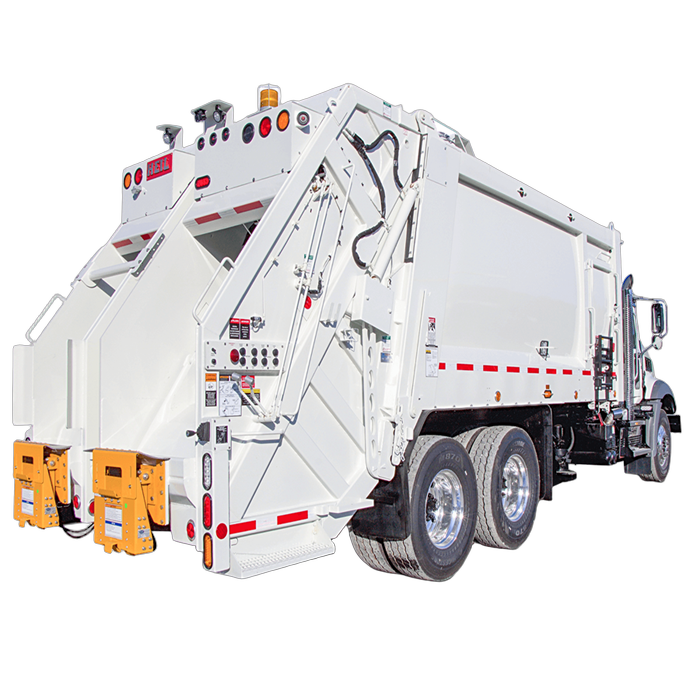
- Rear loader: Waste is loaded into a hopper at the back, manually or via a bin lifter, then compacted by a hydraulic packer plate. The most versatile and flexible configuration.
- Front loader: Hydraulic forks lift large commercial dumpsters up and over the cab, tipping them into the body. Built for high-volume commercial and industrial waste.
- Side loader: Waste is loaded from the side, either manually or with an automated arm that lifts and tips standardised wheeled bins. Automated side loaders (ASLs) run with a single operator.
Function, crew and cost compared
The practical differences come down to what waste each handles, how many people it takes, and what it costs to run.
| Factor | Rear loader | Front loader | Side loader |
|---|---|---|---|
| Best waste | Mixed, bulky, irregular | Large commercial dumpsters | Standardised kerbside carts |
| Typical crew | Driver plus 1-2 runners | Single operator | Single operator |
| Best route | Mixed, older, non-standard | Commercial and industrial | High-density residential |
| Compaction | Good | High (up to ~5:1) | High |
| Upfront cost | Generally lowest | Higher | Higher |
Crew is where the running-cost gap opens. A rear loader's flexibility comes at the price of labour, since it typically needs runners as well as a driver. Automated side and front loaders shift that cost into the machine: higher to buy, but a single operator per route. On a busy council contract, cutting one crew member per route can offset a side loader's higher purchase price within a couple of years.
Matching the loader to your route
The route almost always settles the choice:
- High-density residential, standardised bins: An automated side loader delivers the lowest cost per bin through single-operator speed and fast cycle times.
- Commercial and industrial dumpsters: A front loader empties large bins quickly with one operator, the efficient choice for shopping centres, factories, and office parks.
- Mixed, older, or non-standard routes: A rear loader handles bags, bulky items, and irregular waste that automated systems cannot, making it ideal where flexibility beats raw speed.
- Split streams on one round: Split-body rear loaders can collect refuse and recyclables in separate compartments on the same pass.
Operators running both residential and commercial work usually spec more than one body type, or lean on a rear loader where a single truck must cover varied jobs.
Don't overlook compliance and running costs
Whichever loader you choose, the heavy-vehicle rules apply. Trucks over 4.5 tonnes GVM sit under the Heavy Vehicle National Law, garbage trucks commonly require a Heavy Rigid (HR) licence, and rear and side loaders used in kerbside collection are subject to SafeWork guidelines on operator safety, visibility aids, and bin-lifter certification. Newer diesel trucks must meet current emission standards, and some councils now specify low or zero-emission vehicles in urban contracts. Total cost of ownership, including fuel, maintenance, downtime, crew, and resale, matters more than the purchase price alone.
A realistic scenario
Picture a council weighing up a fleet renewal for a growing suburb of new estates with uniform wheelie bins, alongside an older inner ring of mixed housing and a strip of commercial premises.
No single truck serves all three well. The new estates, with standardised carts neatly presented at the kerb, are ideal for automated side loaders running one operator each. The commercial strip, with its large dumpsters, suits a front loader. The older mixed streets, with bulky and irregular waste and inconsistent bin placement, need the flexibility of a rear loader. The council specs each body type to its route rather than forcing one configuration across all three and accepting poor productivity everywhere. If part of the work involves bulk or construction waste in large containers, it is worth weighing a hooklift or skip system too, as set out in the skip loader vs hook loader guide. For a fuller view that adds body size and lift decisions on top of loader type, see the companion which garbage truck to buy guide, and browse current garbage truck listings to compare configurations.
Frequently asked questions
Which garbage truck is best for residential collection?
For high-density residential routes with standardised wheelie bins, an automated side loader is usually best. It runs with a single operator, cycles quickly, and delivers the lowest cost per bin. Rear loaders suit older or mixed residential areas where bins are inconsistent or bulky waste is common.
What is the difference between a front and rear loader?
A front loader uses hydraulic forks to lift large commercial dumpsters over the cab, running one operator on high-volume commercial routes. A rear loader is loaded at the back, manually or via a bin lifter, and handles mixed and bulky waste flexibly but usually needs a driver plus runners.
How many crew does each loader type need?
Automated side loaders and front loaders typically run with a single operator. Rear loaders usually need a driver plus one or two runners to load bins and bags. That labour difference is a major running-cost factor and often justifies the higher purchase price of an automated truck.
Do I need a special licence to drive a garbage truck?
Usually yes. Most garbage trucks exceed 8 tonnes GVM and carry three or more axles, which requires a Heavy Rigid (HR) licence in Australia. Smaller units may fall under Light or Medium Rigid, but garbage-class trucks commonly sit in the HR bracket, requiring a car licence held for two years first.
Which loader has the lowest running cost?
It depends on the route. On standardised residential rounds, automated side loaders have the lowest cost per bin; on commercial dumpster routes, front loaders win on cost per lift. Rear loaders are cheapest to buy and most flexible, but their crew requirement raises the cost per bin on standardised routes.
What matters most
There is no universally best loader, only the one matched to your route. Standardised residential rounds reward an automated side loader, commercial dumpster work rewards a front loader, and mixed or irregular collection rewards the flexibility of a rear loader. Weigh crew requirements and compaction against purchase price, judge the decision on total cost of ownership, and confirm the licensing and safety obligations before you sign. Match the loader to the work and it pays back shift after shift; mismatch it and you lose money on every bin.
Ready to compare garbage trucks for your routes? Get quotes from garbage truck suppliers across Australia here.
-160x160-state_article-rel-cat.png)
-160x160-state_article-rel-cat.png)