
Key takeaways
Meat products need a state licence or accreditation: in NSW, businesses that handle, process, pack or store red meat or poultry need a NSW Food Authority licence. In Victoria, a further meat processing facility licence is now issued by Safe Food Victoria, which replaced PrimeSafe on 1 July 2026. In Queensland, meat processors need Safe Food Production Queensland accreditation.
Audits are part of the licence: Victorian further meat processing facilities are audited every year, and those making smallgoods every six months.
Allergen labelling rules have tightened: the Plain English Allergen Labelling stock-in-trade period, which let food packaged and labelled before 25 February 2024 be sold with old-format labels, ended on 25 February 2026. Wheat is declared as "wheat", and gluten is declared separately where the food contains gluten, as it does when wheat flour is used.
Your coating line is an allergen risk: shared breaders, batter tanks and fryers can carry wheat, egg, milk, soy or sesame from one product to the next, so changeovers and cleaning should be validated and documented in your food safety program.
Equipment must be cleanable: Food Standards Code Standard 3.2.3 requires equipment to be easily and effectively cleaned, which favours tool-free disassembly and open frames.
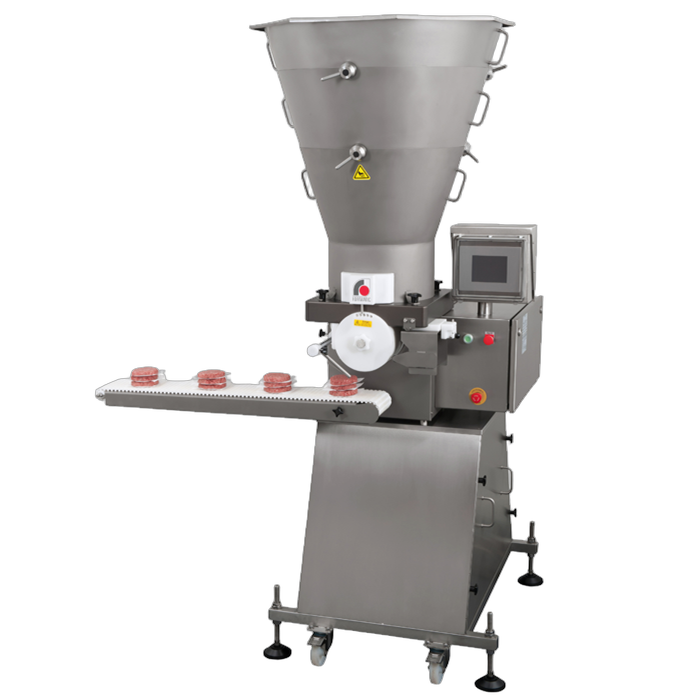
Buying a patty former or breader is the easy part. Selling what it makes usually requires the right licence or registration, a food safety program, accurate allergen labels and a line that can be cleaned between products. This guide covers the requirements Australian businesses typically meet when they make burgers, nuggets, meatballs, crumbed fillets, fish cakes or plant-based patties.
Licensing: which regulator applies
State | Regulator | When you need a licence or accreditation | What it involves |
|---|---|---|---|
New South Wales | NSW Food Authority | Your business handles, processes, packs or stores red meat or poultry, including retail butchers; also seafood wholesalers | Licence under the Food Regulation; an audited food safety program may be required depending on activities |
Victoria | Safe Food Victoria (formerly PrimeSafe) | You process, pack, wholesale or store meat for human consumption (further meat processing facility) | Inspection before licensing; annual audits, or six-monthly if you make smallgoods; fees based on throughput |
Queensland | Safe Food Production Queensland | You process meat or smallgoods for sale; retail butchers processing more than 1 tonne a week for wholesale | Accreditation and a food safety program before you start operating |
Other states and territories | State meat or food safety regulator | Check whether further meat processing is licensed or notified | Confirm before you commission the line |
Victoria's change of regulator did not change obligations: existing PrimeSafe licences, audits and contacts carried across to Safe Food Victoria on 1 July 2026.
Requirements depend on the activity, product and scale. Not every food manufacturer needs the same licence, and an audited food safety program applies only to some licensed activities. Plant-based patties, vegetable fritters and similar products are generally regulated as food manufacturing, which in NSW typically means notifying the regulator rather than holding a licence. Check with your state regulator before you assume either way, especially if you share a line between meat and non-meat products.
Standards that may apply to your premises and line
Australian Standard AS 4696:2023: Queensland lists this standard for the hygienic production and transportation of meat and meat products, and Victorian licence conditions require compliance with the relevant Australian standards.
Food Standards Code Standard 4.2.3 (meat) and 4.2.2 (poultry meat): the national primary production and processing standards for meat and poultry. Which parts apply depends on your operation, so confirm with your regulator how they relate to the activities you carry out.
Food Standards Code Standards 3.2.2 and 3.2.3: food handling, cleaning and sanitising, and the design of premises and equipment.
If you cook, fry or freeze products in-line and sell them ready to eat, Listeria control becomes a central part of the food safety program. Victorian regulators publish specific technical guidance on Listeria management for ready-to-eat meat products.
Allergens: what coatings add to your label
Coatings are the main source of allergens in formed products. Crumbs and batters commonly contain wheat, and many contain egg, milk, soy or sesame. Under Plain English Allergen Labelling, these must be declared using the prescribed plain English names, in bold, with a summary statement beginning "Contains". Food packaged and labelled before 25 February 2024 could be sold with old-format labels until 25 February 2026. That stock-in-trade period has ended, so packaged food on sale must now carry PEAL-compliant declarations, subject to the exemptions in the Food Standards Code.
Wheat and gluten are separate declarations. Wheat is declared as "wheat" where it is present as an allergen, and gluten is declared where the food contains gluten. A crumb or batter made with wheat flour triggers both, so "Contains gluten" alone is not enough. Some wheat-derived ingredients are treated differently, so check the Code's requirements for each ingredient in your coating.
What allergen control means for your equipment
These are good-practice controls rather than prescribed legal steps; your food safety program and auditor set the detail for your site.
Changeovers: batter tanks, crumb hoppers and recirculation systems hold residue. Plan production from allergen-free to allergen-containing products, or dedicate equipment.
Cleaning validation: show that your cleaning procedure removes allergen residue from formers, breaders and conveyors, and keep records.
Dedicated tooling: consider separate mould plates, drums or crumb systems for allergen-free or gluten-free lines.
Shared fryers: oil carries allergens between products, so a shared fryer affects every product that goes through it.
Hygienic design checklist
Standard 3.2.3 sets the legal outcome, equipment that can be easily and effectively cleaned, rather than specific designs. The features below are good practice for meeting it.
Food-contact parts in stainless steel or food-grade plastics
Tool-free removal of drums, mould plates, belts and hoppers for cleaning
No hollow sections, ledges or threads where mince or batter collects
Washdown-rated motors, sensors and electrical enclosures
Crumb and batter systems that empty fully between products
Guarding, interlocks and emergency stops that do not block cleaning access
Cleaning and allergen changeover records built into your food safety program
For how forming and coating technologies differ, see [Article 3: Drum, Plate or Encrusting Former?]. For budgets, see [Article 1: Food Forming and Coating Machine Cost in Australia].
Compare suppliers: request quotes from food forming and coating machine suppliers on IndustrySearch and ask each how their equipment supports cleaning, allergen changeovers and your licence audit.
Frequently asked questions
Do I need a licence to make burger patties for wholesale?
Usually, yes, depending on your state and activity. Making and supplying meat products for sale is licensed by the NSW Food Authority, Safe Food Victoria and Safe Food Production Queensland, and in other states you should confirm the requirement with the meat or food safety regulator.
Who regulates meat processing in Victoria now?
Safe Food Victoria, which took over from PrimeSafe and Dairy Food Safety Victoria on 1 July 2026. Existing licences remain valid.
Do plant-based patties need a meat licence?
Generally not, unless they are made in a licensed meat facility or contain meat. They are usually regulated as food manufacturing, but confirm with your state regulator.
How do I label a crumbed chicken product with wheat flour?
Declare wheat in the ingredient list in bold, and include a summary statement such as "Contains wheat, gluten", plus any other allergens in the batter or crumb.
Can I run gluten-free and crumbed products on the same line?
Only with validated cleaning and careful scheduling. Dedicated coating equipment for allergen-free products removes most of the cross-contact risk.