
Key takeaways
Factor | Typical Range / Value | Buyer Implication |
|---|---|---|
Throughput range (powered) |
500 – 6,000+ cartons/hour |
Rated throughput assumes consistent product flow — actual throughput depends on layout, merges and product mix |
Speed range (powered) |
10 – 60 m/min |
Higher speed does not always mean higher throughput — accumulation and gap control matter more |
Price range (AUD 2026) |
$200 – $3,000 per metre |
Gravity at the low end; powered MDR with zone control at the high end |
Primary bottleneck |
Merge and divert points |
Straight-line speed is rarely the limit — transitions between zones are where throughput drops |
Gap control |
50 – 200 mm between products |
Tighter gaps increase throughput per metre but require zone-controlled powered rollers |
Load capacity |
30 – 150 kg per metre |
Rate to peak accumulation load, not just single-product weight |
What actually determines roller conveyor throughput
Roller conveyors are rated by speed (metres per minute) and load (kilograms per metre), but the throughput you actually achieve — cartons per hour through the full system — is governed by product spacing, merge point capacity and accumulation zone design. Australian distribution centres and fulfilment operations routinely spec conveyors to a headline speed figure, then discover the system delivers 20–40% less throughput because the bottleneck sits at a merge, divert or manual station rather than on the straight-line conveyor sections.
This guide explains how to calculate realistic throughput for your operation, where bottlenecks form, and which specifications to prioritise when requesting quotes. Compare roller conveyor systems from verified Australian suppliers on IndustrySearch to source solutions matched to your throughput requirements.
Throughput planning is critical for:
- E-commerce fulfilment centres processing 1,000–10,000+ orders per day
- 3PL distribution centres handling mixed-SKU dispatch
- Manufacturing pack-out lines feeding palletising or shipping
- Cold chain logistics operations in VIC and QLD with strict throughput windows
Calculate your required throughput
Before selecting a conveyor speed or system length, define the throughput target your system must achieve. This sets every downstream specification.
Variable | How to Calculate | Example |
|---|---|---|
Daily dispatch volume |
Total cartons or units dispatched per day |
3,000 cartons/day |
Operating hours |
Hours of active conveyor operation per day |
8 hours |
Average throughput required |
Daily volume ÷ operating hours |
375 cartons/hour |
Peak throughput factor |
1.5–2.0× average (for surge periods) |
560–750 cartons/hour peak |
Design to peak throughput, not average. A system that handles 375 cartons/hour will back up during the 2–3 hour peak periods that every distribution centre experiences. Building in a 1.5–2.0× peak factor costs 10–20% more at installation but avoids $15,000–$40,000 in retrofit costs later.
Evaluate the specifications that drive throughput
With your throughput target confirmed, these are the specs that determine whether the system delivers it consistently.
Specification | Typical Range | Buyer Consideration |
|---|---|---|
Conveyor speed |
10 – 60 m/min |
Speed × product density = throughput — but only if gaps and merges are controlled |
Product gap (spacing) |
50 – 200 mm |
Tighter gaps increase throughput per minute but require zone-controlled powered rollers |
Zone control |
24V MDR with photo-eye sensors |
Each zone stops independently to maintain spacing — eliminates product collision and back-pressure |
Merge point capacity |
Rate to 120% of combined feed volume |
The most common throughput bottleneck — must exceed the combined input rate |
Accumulation length |
3–10 product lengths per zone |
Buffers flow variations — without it, a single slow station stops the entire line |
Drive type |
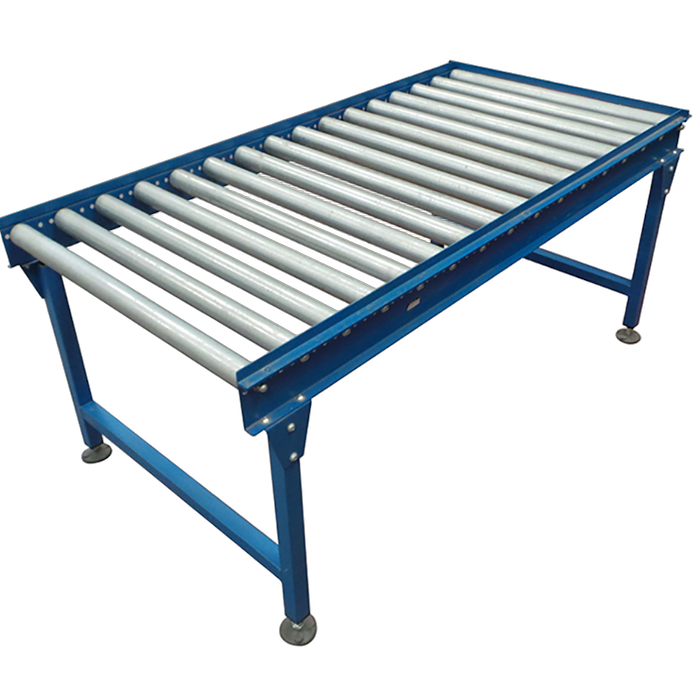
Gravity, lineshaft, or MDR (motorised drive roller) |
MDR gives per-zone control; lineshaft is lower cost but less flexible; gravity suits decline and low-volume straight runs |
Understand the full cost breakdown (2026 prices)
Purchase price is only part of the picture — the cost per carton throughput varies significantly between drive types and layout complexity.
Category | Price Range (AUD per metre) | Typical Configuration |
|---|---|---|
Gravity roller |
$200 – $600 |
Straight runs, decline sections, low-volume pack stations |
Powered — lineshaft |
$500 – $1,500 |
Continuous-drive straight sections, mid-volume warehouses |
Powered — MDR (zone-controlled) |
$1,200 – $3,000 |
Accumulation zones, merge/divert control, high-throughput DC systems |
Curves and diverts |
$2,000 – $8,000 per unit |
Tapered roller curves; pop-up divert wheels or pusher diverts |
Annual maintenance (full system) |
$2,000 – $15,000 |
Bearing replacement, belt/O-ring checks, sensor calibration, motor service |
For a mid-size DC in Sydney processing 3,000 cartons/day across a 40 m system, expect $40,000–$100,000 depending on the mix of gravity and powered sections. MDR zone-controlled sections add $20,000–$50,000 but deliver 30–50% higher sustained throughput than lineshaft equivalents by eliminating back-pressure at merges. Request quotes from roller conveyor suppliers on IndustrySearch to compare throughput per dollar across drive types.
Plan the asset (depreciation and financing)
The ATO effective life for conveyor systems is 15 years. Under diminishing value, the depreciation rate is 13.33%; prime cost is 6.67% per annum. Systems designed with modular sections (bolt-together frames, relocatable MDR zones) retain higher resale value and can be reconfigured if your warehouse layout changes.
Evaluate suppliers
You are ready to go to market. Use this checklist to assess each supplier against the same criteria.
Factor | What to Ask |
|---|---|
Throughput guarantee |
Will the supplier guarantee a sustained throughput rate (cartons/hour) for your product mix? |
Layout design |
Is a CAD layout review included in the quotation — validated against your product range? |
Merge/divert capacity |
How are merge and divert points rated — at 100% or 120%+ of combined feed volume? |
Zone control |
Are powered sections zone-controlled (MDR) or continuous-drive (lineshaft)? |
Product testing |
Will the supplier test your actual product range on the proposed system before sign-off? |
Expansion design |
Does the layout allow for additional lines, zones or pack stations without structural rework? |
Installation and commissioning |
Is installation, commissioning and throughput validation included in the price? |
Warranty |
Coverage on frames, rollers, motors and controls — duration and exclusions? |
Maintenance contract |
Preventive maintenance available? What is the annual cost? |
Reference sites |
Can you visit a comparable system operating at a similar throughput in Australia? |
Frequently asked questions
How many cartons per hour can a powered roller conveyor handle?
A standard powered roller conveyor at 30 m/min with 150 mm product gaps handles roughly 1,200–1,800 cartons per hour on straight-line sections. Actual system throughput is lower — typically 60–80% of straight-line capacity — due to merge, divert and accumulation constraints.
What is the difference between lineshaft and MDR in throughput terms?
MDR (motorised drive roller) systems offer per-zone speed and accumulation control, delivering 30–50% higher sustained throughput than lineshaft on systems with multiple merge or divert points. Lineshaft is lower cost but runs all rollers at the same speed, creating back-pressure at transitions.
Should i design to average or peak throughput?
Always design to peak. A system that handles average throughput will back up during the 2–3 hour surge periods every distribution centre experiences. The 1.5–2.0× peak factor costs 10–20% more at installation but prevents costly retrofit later.
How does product mix affect throughput?
Mixed carton sizes require different gap spacing and may need wider roller pitch to avoid jams. A system designed for a single carton size will lose 15–30% throughput when processing a varied product mix — always spec to your full range.
Summary
- Rated conveyor speed does not equal system throughput — merges, diverts and accumulation set the actual rate
- Design to peak throughput (1.5–2.0× average) to avoid costly retrofit
- MDR zone-controlled systems deliver 30–50% higher sustained throughput than lineshaft at transitions
- Merge points are the most common bottleneck — rate to 120% of combined feed volume
- Test the system against your full product mix before sign-off — not just the average carton size
- Powered conveyor systems cost $500–$3,000 per metre depending on drive type and zone control
Ready to source your roller conveyor system?
Don’t waste time contacting suppliers individually. IndustrySearch gives you direct access to verified Australian roller conveyor suppliers — compare systems, specs and pricing in one place, then request quotes from suppliers best matched to your operation.
- Compare models — filter by type, capacity and region
- Request quotes — contact multiple verified suppliers with a single enquiry
- Contact suppliers directly — speak to specialists who service your state
→ Compare Roller Conveyors on IndustrySearch Now →


-160x160-state_article-rel-cat.jpg)
-160x160-state_article-rel-cat.png)