
Key takeaways
| Factor | Detail |
|---|---|
| National Minimum Wage (July 2025) | $24.95/hour — up 22.7% ($4.62/hour) over three years |
| Body stressing claims (2023–24) | 50,600 serious workers’ compensation claims — 34.5% of all serious claims nationally |
| Average serious claim cost | $16,300 median payout plus 7.4 weeks lost productivity per claim |
| Manual hydraulic scissor lift trolley | $800–$2,500 AUD — suits low-to-moderate lift frequency, 150–1,000 kg |
| Electric scissor lift trolley | $2,000–$5,500 AUD — suits high-frequency use and loads to 1,000 kg |
| Double scissor / high-lift models | $3,000–$7,500 AUD — lifts to 1,575 mm, suited to tall shelving and dispatch |
| WHS compliance obligation | WHS Regulations 2017 — hazardous manual tasks must be eliminated or minimised; AS/NZS 4600 applies to machine construction |
The labour cost pressure changing equipment decisions
Australia’s National Minimum Wage reached $24.95 per hour from 1 July 2025 — a 3.5% increase and part of a 22.7% cumulative rise over three years. For warehousing, logistics, manufacturing and retail operations where labour is the dominant cost line, each annual Fair Work Commission review directly increases the cost of every manually performed task. Repetitive low-value physical work — lifting, repositioning, loading — becomes measurably more expensive each July.
The pressure works two ways. Higher wages make every manual handling task more expensive per hour. And the injury risk attached to those tasks carries its own cost: Safe Work Australia data shows body stressing — the mechanism behind most lifting and handling injuries — generated 50,600 serious workers’ compensation claims in 2023–24, with a median payout of $16,300 and 7.4 weeks off work per claim. That is a direct employer liability, before downtime, retraining and lost throughput are counted.
A scissor lift trolley priced at $1,500–$4,000 that prevents a single body stressing claim pays for itself before a replacement operator is trained. The ROI calculation has shifted materially as wages and claim costs have both risen since 2022.
What a scissor lift trolley solves — and where it’s used
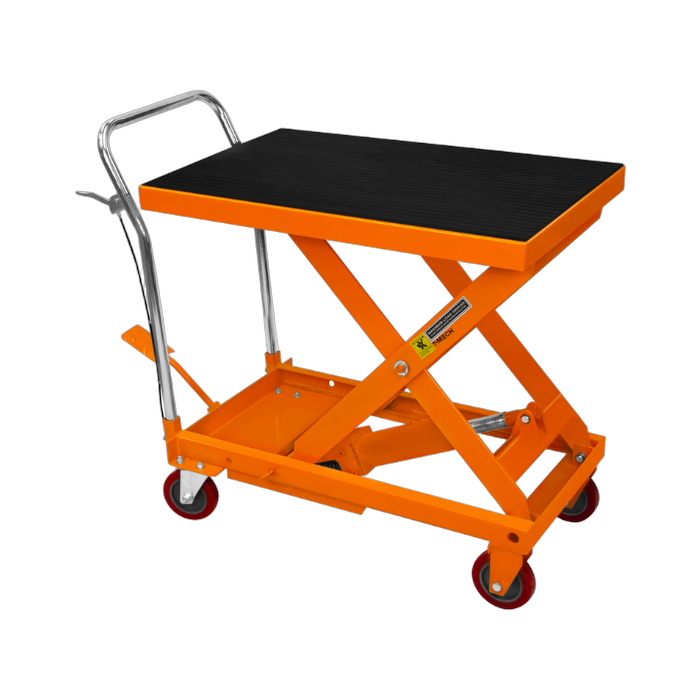
A scissor lift trolley combines a standard wheeled trolley with a hydraulic or electric lifting mechanism, allowing an operator to raise or lower a load to working height at the point of use — eliminating the sustained bending, awkward reach and load-bearing postures that drive musculoskeletal injuries. The load is moved and then positioned at waist height, not lifted from the floor by the operator.
The tasks where this matters most are exactly those that have become most expensive under sustained wage growth: repetitive loading and unloading at benches or shelves, positioning items in receiving areas, and moving product between height-mismatched workstations. These operations are performed dozens or hundreds of times per shift by workers whose loaded hourly cost has risen by over $4.60 since 2022.
Industries driving demand in 2025–26 include:
- Warehousing and distribution — receiving, put-away and dispatch
- Manufacturing and assembly — component positioning at workstations
- Food processing — including stainless steel models for hygienic environments
- Retail replenishment — shelf-height loading from trolley to fixture
- Healthcare — equipment and supply movement in clinical settings
- Hospitality — linen, cellar stock and kitchen supply handling
Machine types and AUD pricing (2025–2026)
| Type | Lift Mechanism | Price Range (AUD) | Best For |
|---|---|---|---|
| Manual hydraulic | Foot-operated pump raises platform; hand lever lowers | $800–$2,500 | Low-to-moderate frequency; 150–1,000 kg; tight budgets |
| Electric (battery) | Push-button 12V motor raises and lowers; manual push to move | $2,000–$5,500 | High-frequency lifting; heavier loads; operators with physical limitations |
| Double scissor / high-lift | Dual scissor mechanism reaches 1,400–1,575 mm lift height | $3,000–$7,500 | Tall shelving, dispatch benches, mezzanine-level positioning |
| Stainless steel | Hydraulic or electric — same operation, SS construction | $2,500–$6,500 | Food processing, healthcare, wet environments, cleanrooms |
Pricing based on Australian supplier market data 2025–26, excluding GST. Prices vary by capacity, lift height and brand. Used units available from ~$400 for manual hydraulic models.
Key specifications buyers should evaluate
| Specification | Typical Range | Buyer Consideration |
|---|---|---|
| Load capacity | 150–2,000 kg | Rate against your heaviest regular load, not average — never operate above rated SWL |
| Lift height (max) | 800–1,575 mm | Match to your bench or shelf height; double scissor required above ~900 mm |
| Platform dimensions | 500×500 mm to 2,050×750 mm | Must accommodate your largest load footprint with clearance on all sides |
| Lowered height | 170–350 mm | Lower is better for floor-level loading; confirm it fits under your pallets or bins |
| Castor type | Polyurethane or nylon; 2 fixed + 2 swivel with brakes | PU castors suit smooth concrete; confirm brake effectiveness under rated load |
| Power source | Manual / 12V battery / AC mains | Battery suits mobile use; confirm charge time and battery life per shift before committing |
Manual hydraulic vs electric — which to choose
| Factor | Manual Hydraulic | Electric (Battery) |
|---|---|---|
| Lift operation | Foot pump — requires operator effort | Push-button — zero operator lifting effort |
| Best lift frequency | Up to ~20 lifts/shift comfortably | Unlimited — consistent effort at any volume |
| Purchase cost | $800–$2,500 | $2,000–$5,500 |
| Maintenance | Hydraulic fluid checks; minimal servicing | Battery care; annual service recommended |
| Injury risk reduction | High — eliminates bending; foot pump is low effort | Highest — zero physical input to raise load |
| Suited to | Occasional-use workstations, tight budgets | High-frequency operations, ageing workforce, heavy loads |
Choose manual hydraulic when lift frequency is low to moderate and budget is the primary constraint. The foot pump requires minimal effort and the injury reduction versus unaided manual handling is substantial even at this price point.
Choose electric when operators lift repeatedly throughout a shift, loads are at the heavier end of the range, or your workforce includes older workers or those managing existing musculoskeletal conditions.
Costs in Australia — purchase and running costs (2025–2026)
| Category | Price Range (AUD, excl. GST) | Notes |
|---|---|---|
| Entry manual hydraulic (300–500 kg) | $800–$1,500 | Standard deck, single scissor, foot pump, basic castors |
| Mid-range manual hydraulic (500–1,000 kg) | $1,500–$2,500 | Larger deck, safety overload bypass valve, lockable wheels |
| Entry electric (300–500 kg) | $2,000–$3,500 | 12V battery, push-button, 2 fixed + 2 swivel castors with brakes |
| Mid-range electric (500–1,000 kg) | $3,500–$5,500 | Heavier duty frame, extended battery life, auto charger included |
| Double scissor / high-lift | $3,000–$7,500 | Lifts to 1,575 mm; manual or electric; suited to tall-bay applications |
| Stainless steel (food/medical grade) | $2,500–$6,500 | SS316 or SS304 depending on environment; corrosion-resistant |
| Annual maintenance (all types) | $150–$600 | Hydraulic fluid, seal checks, castor inspection, battery service (electric) |
Total cost of ownership over 5–8 years (typical machine lifespan) is low relative to purchase price. Annual maintenance on a manual hydraulic unit is minimal — hydraulic fluid, seal inspection and castor checks. Electric models require periodic battery service and annual inspection. Neither carries significant running costs compared to the labour cost of the manual alternatives they replace.
Australian WHS compliance
- WHS Regulations 2017 require employers to eliminate or minimise hazardous manual tasks — scissor lift trolleys are a recognised engineering control at the highest level of the hierarchy of controls
- Safe Work Australia defines repetitive lifting and sustained awkward postures as primary musculoskeletal disorder risk factors — documented risk assessments are required where these hazards are identified
- Machines must comply with AS/NZS 4600 (cold-formed steel structures) and carry a rated Safe Working Load (SWL) — confirm SWL marking is visible on every unit before purchase
- Operators should be instructed in load limits, correct platform loading technique and brake engagement — no formal licence is required for ground-level scissor lift trolleys
- Pre-use inspection is a WHS obligation — hydraulic integrity, castor brakes and platform condition should be checked each shift
- Stainless steel models required in food processing environments under the FSANZ Food Standards Code where equipment contacts food or food-contact surfaces
Supplier comparison checklist
| Factor | What to Ask |
|---|---|
| SWL certification | Is the rated Safe Working Load independently certified and marked on the unit? |
| Australian Standards compliance | Does the machine comply with AS/NZS 4600 and relevant WHS equipment standards? |
| Lift height vs your application | Can the supplier confirm the maximum lift height matches your bench, shelf or vehicle height? |
| Overload protection | Does the hydraulic model include a safety overload bypass valve to prevent operation above SWL? |
| Castor brake rating | Are brakes rated to hold the trolley under full load on your floor surface? |
| Battery life (electric models) | How many full lift cycles per charge — and does this cover a full shift at your expected frequency? |
| Parts availability | Are hydraulic seals, castors and battery components stocked in Australia or imported to order? |
| Warranty | What is the warranty period and does it cover parts and labour, or parts only? |
Frequently asked questions
How does a scissor lift trolley differ from a scissor lift table?
A scissor lift table is a fixed or semi-fixed workstation platform — it stays in place and the work comes to it. A scissor lift trolley is mobile: it moves with the operator and the load, combining a wheeled trolley frame with an integrated lifting mechanism. The trolley is the right choice when loads need to be transported as well as raised, which covers the majority of warehouse and production floor applications.
What load capacity does a standard warehouse operation need?
Most warehouse and distribution applications are covered by 300–500 kg capacity units — this range accommodates cartons, totes, drums and most production components. Operations handling palletised loads or heavy machinery components should evaluate 1,000 kg models. The key rule is to rate the trolley against your heaviest regular load, not your average load, and never operate above the marked SWL.
Is a scissor lift trolley considered a hazardous manual task under WHS regulations?
The trolley itself is an engineering control that eliminates or minimises hazardous manual tasks — it is the solution, not the hazard. Under WHS Regulations 2017, employers must work through the hierarchy of controls to manage manual task risks; a scissor lift trolley sits at the engineering control level, which is more effective than administrative controls or PPE. Operators still need instruction on load limits, brake engagement and pre-use checks, but no formal licence is required for ground-level models.
How long do scissor lift trolleys typically last in a warehouse environment?
A well-maintained manual hydraulic unit typically lasts 7–12 years in moderate-use warehouse environments. Electric models have a similar frame lifespan, with batteries requiring replacement every 3–5 years depending on charge cycles and storage conditions. The most common maintenance items are hydraulic seals (manual models) and castor replacement — both are low-cost relative to the unit purchase price and readily available from Australian suppliers.
Summary
- Rising wages make every manually performed lift more expensive — at $24.95/hour base rate, the labour cost of repetitive manual handling compounds daily across a full shift roster
- Body stressing is the single largest category of serious workers’ compensation claims — 50,600 claims in 2023–24, each costing a median $16,300 plus 7.4 weeks of lost productivity
- Manual hydraulic models at $800–$2,500 deliver the majority of the ergonomic benefit for moderate lift frequency — electric models are justified at high frequency or for heavy loads
- Match capacity to your heaviest regular load and lift height to your actual bench or shelf height — these two specifications determine whether a unit is fit for your application
- WHS Regulations 2017 require engineering controls for hazardous manual tasks — documented risk assessment and equipment selection are legal obligations, not optional improvements
- At 5–8 year machine lifespan and $150–$600 annual maintenance, TCO is low — the financial case is driven by injury prevention and labour productivity, not equipment running costs
Ready to source your scissor lift trolley?
Don’t waste time chasing individual suppliers. IndustrySearch gives you direct access to verified Australian scissor lift trolley suppliers — compare models, capacities and pricing in one place, then request quotes from suppliers best matched to your operation.
- Compare models — filter by capacity, lift height, power type and region
- Request quotes — contact multiple verified suppliers with a single enquiry
- Contact suppliers directly — speak to specialists who service your state