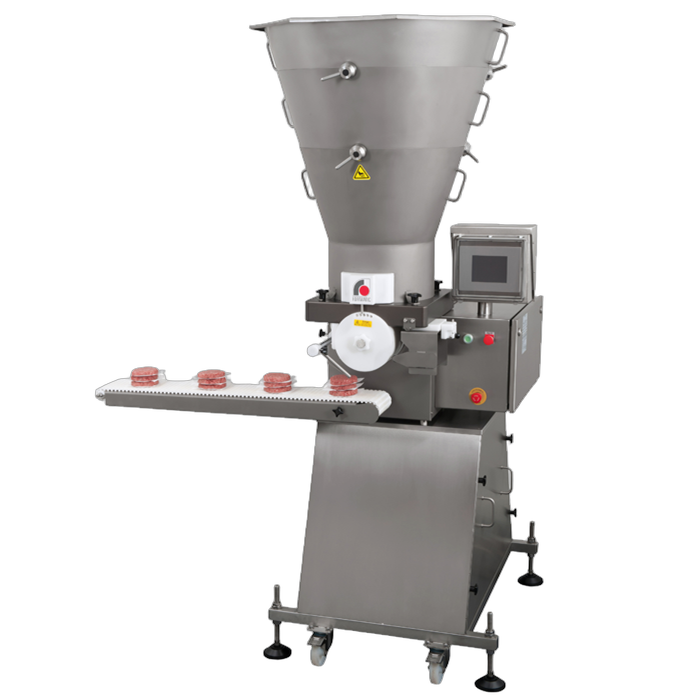

Key takeaways
Australian retail and overseas prices differ: at one Australian supplier, a meatball former retails from A$3,740 and a Mainca HA Series automatic burger former at A$18,260, both including GST. Overseas list prices are not landed costs: the Formatic D12000 dual-lane drum former lists in the UK at about A$70,700 before freight, duty and GST.
Coating machines: used predust, batter and breading machines from brands such as GEA, Marel, JBT and Stein are advertised from about A$8,100 to A$81,000. New industrial coating lines are quoted per project.
Output drives price: the Formatic drum former range is listed at about 1,000 to 24,000 products an hour, with the top figure for the wider C-series, and actual output depends on product size and weight. Each step up in drum width, lanes or automation adds cost.
The machine is not the whole budget: extra mould plates or drums for each shape, paper interleaving or stacking, matched conveyor widths, batter mixers, and any fryer, oven or freezer are usually priced separately, so compare installed cost rather than machine price.
Tax: a single machine under $20,000 can be written off immediately by small businesses with aggregated turnover under $10 million that use the simplified depreciation rules, for the portion used for a taxable purpose. Complete lines go into the small business pool.
Food forming and coating equipment in Australia costs from about A$3,700 for a small meatball former to well over A$70,000 for a high-output former, and considerably more once you add coating, frying and freezing. The right budget depends on product type, output per hour and how much of the line you automate. This guide covers forming, portioning and coating machines for patties, nuggets, meatballs, croquettes, fish cakes and plant-based products.
Forming and coating equipment prices
The prices below come from three different kinds of source, so they are grouped rather than blended into one Australian range.
Australian retail prices (including GST)
Equipment | Model | Price | Reference point |
|---|---|---|---|
Meatball or ball former | SYSTEM B Rolly to Mainca FA-1500 | A$3,740 to A$11,110 inc GST | Barnco |
Automatic burger former | Mainca HA Series | A$18,260 inc GST | Barnco |
Imported new or overseas list prices (excluding freight, duty and Australian GST)
Equipment | Model and listed output | Price | Reference point |
|---|---|---|---|
Entry-level automatic burger former | WM-MPF100, listed at 2,100 patties an hour | About A$4,800 | Chinese manufacturer listing |
Rotary drum former | Formatic R1200 to D12000 | About A$9,000 to A$70,700 | UK retailer list prices; check VAT treatment |
Industrial burger former | Rex UFM 300-5 | About A$53,400 | UK retailer list price |
Used equipment listed overseas
Equipment | Price | Reference point |
|---|---|---|
Patty forming machines | About A$1,300 to A$50,800 | Machinio listings |
Used Patty-O-Matic automatic formers | About A$7,000 to A$9,900 | eBay listings |
Predust, batter and breading machines (GEA, Marel, JBT, Stein) | About A$8,100 to A$81,000 | Exapro listings |
Complete forming, coating, frying and freezing lines are quoted per project.
Imported entry-level nugget lines are advertised from about A$14,200, but treat any "complete line" at that price with caution until you see the module list, belt width and output. The IndustrySearch listing range of $20,000 to $100,000 reflects mid-range formers and coating machines rather than complete lines.
What changes the price
Output per hour: drum width, number of lanes and stroke rate set the price more than anything else.
Forming method: rotary drum, mould plate, ball forming and encrusting machines differ widely in cost and capability (see [Article 3: Drum, Plate or Encrusting Former?]).
Product range: every extra shape usually needs its own mould plate, drum or nozzle set, although some machines change portion weight or thickness by adjustment rather than new tooling.
Handling after forming: paper interleaving, stacking (some formers stack patties up to 100 mm high) and automatic traying each add a module but remove manual handling.
Coating complexity: a single breader costs far less than a predust, batter and breading sequence with crumb recirculation and excess-removal blowers.
Hygienic build: full stainless steel, tool-free disassembly and washdown-rated electrics cost more but cut cleaning time.
Local support: Australian parts and technicians, especially for mould plates and seals.
What quotes often leave out
additional mould plates, drums or nozzles for each product shape
infeed and outfeed conveyors at the right belt width for the next machine
batter mixers and holding tanks
fryers, ovens and freezers, with oil filtration and fume extraction if you cook in-line
mince chilling and temperature control upstream of the former
three-phase power, compressed air and installation
operator training, spare parts and wear items such as seals and knives
licensing, food safety program and audit costs for meat products (see [Article 2: Making Formed and Crumbed Foods in Australia])
Ask each supplier to price these separately and to state output at your product weight and mince temperature.
New, used or imported?
Used formers and breaders from established brands are widely available overseas, and a used breading machine can cost a fraction of a new line. The risks are worn mould plates, missing tooling for your shapes and parts availability. Imported new machines from China cost less up front; check stainless grade, food-contact materials, electrical compliance for Australian supply and who will service them.
Tax and finance
The $20,000 instant asset write-off is permanent from 1 July 2026 for businesses with aggregated turnover under $10 million that use the simplified depreciation rules. It applies per asset, and only to the portion of the asset used for a taxable purpose. A meatball former at about A$11,000 or a burger former at about A$18,000 can qualify in the year it is first used or installed ready for use. Assets of $20,000 or more go into the small business pool at 15% in the first year and 30% after. Ask your accountant how a multi-machine purchase should be itemised.
How to get quotes you can compare
Products, shapes and finished weights, including the heaviest and lightest
Required output per hour and shift pattern
Mince or mix type, fat content and the temperature it reaches the former
Coating sequence you need: predust, batter or tempura, crumb or flour
What happens after coating: chilling, frying, oven cooking or freezing
A request to price machine, tooling, conveyors, installation and training separately
Compare quotes: Get quotes from food forming and coating machine suppliers on IndustrySearch to compare output, tooling and support side by side.
Frequently asked questions
How much does a burger patty machine cost in Australia?
A Mainca HA Series automatic burger former retails at A$18,260 including GST at one Australian supplier. Imported entry-level formers are listed from about A$4,800 before freight, duty and GST, and high-output drum formers list overseas at up to about A$70,700.
How much does a meatball machine cost?
About A$3,700 to A$11,100 including GST for small to medium meatball formers sold in Australia.
How much does a breading machine cost?
Used industrial breading and batter machines are advertised from about A$8,100 to A$81,000. New lines are quoted to suit belt width and coating sequence.
How much does a chicken nugget production line cost?
It depends on how many stages you include. A former and breader is a fraction of the cost of a full line with frying, cooking and freezing, which is quoted per project.
Can I instantly write off a patty former?
Yes, if it costs under $20,000, your aggregated turnover is under $10 million, you use the simplified depreciation rules, and it is first used or installed ready for use in the income year. Only the portion used for a taxable purpose can be written off.