
Key takeaways
- Price range: Fiber laser cutters cost $50,000-$500,000+ in Australia. CO2 laser cutters cost $5,000-$80,000 (2026 new pricing).
- Core difference: Fiber lasers cut reflective metals (steel, aluminium, brass, copper) at 2-3x the speed of CO2 with lower running costs. CO2 lasers cut non-metals (acrylic, wood, fabric, leather) and engrave surfaces that fiber lasers cannot process.
- If your primary material is mild steel, stainless steel or aluminium sheet: specify fiber. If your primary material is acrylic, wood, MDF, fabric or leather: specify CO2.
- Running cost gap: Fiber lasers cost $30,000-$60,000/year to run at single-shift utilisation. CO2 lasers cost $8,000-$25,000/year - but this reflects lower power and throughput, not better efficiency per cut.
- Maintenance gap: Fiber laser sources last 80,000-100,000 hours with no gas resonator maintenance. CO2 tubes last 10,000-30,000 hours and require mirror alignment, gas refills and more frequent optics replacement.
- Mixed-material shops: Operations cutting both metal and non-metal need both laser types. A single machine cannot do both efficiently.
Fiber laser vs CO2 laser cutting machine Australia (2026): Speed, material range, running costs and choosing the right laser for your workshop
Fiber and CO2 laser cutting machines are the two dominant laser technologies in Australian fabrication, signage and manufacturing workshops. Both cut with precision, but they cut different materials at different speeds at different price points. Buying the wrong laser type locks a shop into either a material limitation or a running cost penalty that compounds every operating hour. With fiber laser prices starting at $50,000 and CO2 starting at $5,000, the upfront gap is significant - but the per-cut economics often favour the higher-priced machine for metal work.
This guide compares both laser types across material capability, speed, cost and workshop fit. For detailed pricing and TCO analysis, see the laser cutting machine cost guide. To compare quotes, get quotes for fiber laser cutting machines on IndustrySearch.
Workshops where this comparison drives the laser purchase decision:
- Metal fabrication shops cutting mild steel, stainless and aluminium sheet
- Signage and display manufacturers cutting acrylic, timber and composite panel
- Mixed-material workshops processing both metals and non-metals
- Contract cutting operations evaluating throughput and cost per part
Choose your dominant material
Before costing anything, confirm what material makes up 80%+ of your cutting volume. Your answer determines the laser type.
Factor | Fiber Laser | CO2 Laser |
|---|---|---|
Primary materials | Mild steel, stainless, aluminium, brass, copper, titanium | Acrylic, wood, MDF, fabric, leather, rubber, glass engraving |
Metal cutting speed | 2-3x faster than CO2 on metals under 6 mm | Slower on metals. Competitive on thick mild steel above 20 mm |
Non-metal capability | Cannot cut acrylic, wood or organic materials effectively | Excellent edge finish on acrylic, wood, fabric and leather |
Reflective metals | Cuts copper, brass and aluminium without back-reflection risk | Back-reflection damages CO2 optics on copper and brass |
Price range (new) | $50,000-$500,000+ | $5,000-$80,000 |
If 80%+ of your work is metal sheet, fiber is the correct specification. If 80%+ is acrylic, timber or organic materials, CO2 is the correct specification. If the split is closer to 50/50, you need both machines or a fiber for metals and outsource non-metal cutting.
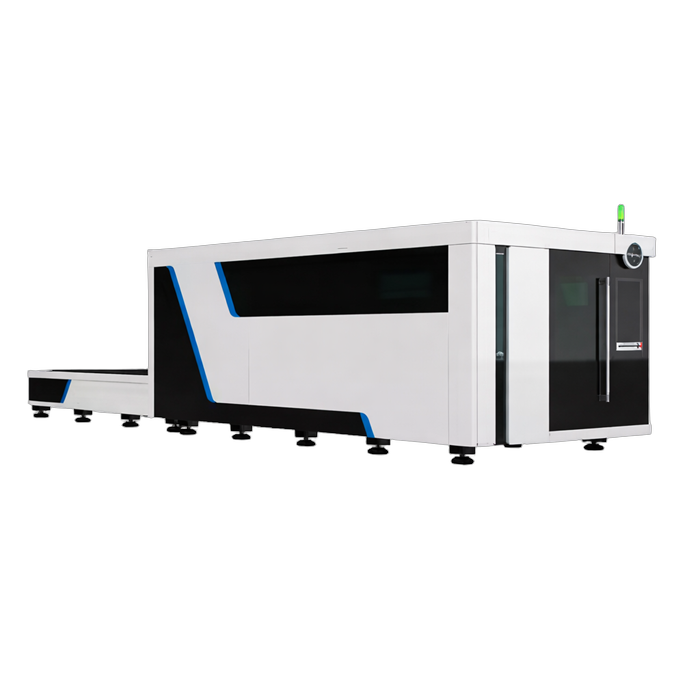
Fiber lasers use a solid-state laser source that delivers the beam through a fiber optic cable. No mirrors, no gas resonator, no alignment. The wavelength (1,070 nm) is absorbed efficiently by metals, producing fast, clean cuts with low heat-affected zones. A 4 kW fiber cuts 6 mm mild steel at 3-4 m/min - roughly 3x the speed of a 150 W CO2 on the same material.
CO2 lasers use a gas mixture (CO2, nitrogen, helium) excited by electrical discharge to produce a beam at 10,600 nm wavelength. This longer wavelength is absorbed by organic and non-metallic materials, producing polished edges on acrylic and clean cuts on wood that fiber lasers cannot match. For signage, display and textile cutting, CO2 remains the standard.
Evaluate the key specifications
With your laser type confirmed, these are the specs that separate models within each category.
Specification | Typical Range | Buyer Consideration |
|---|---|---|
Laser power | Fiber: 1-20 kW / CO2: 40 W-6 kW | Higher power = thicker material capacity and faster speed on thin material |
Bed size | 1,300 x 900 mm to 6,000 x 2,000 mm | Match to your standard sheet size. 3,000 x 1,500 mm covers most Australian steel merchants' standard sheets |
Max cutting thickness | Fiber 4 kW: 20-25 mm mild steel / CO2 150 W: 10-15 mm acrylic | Specify based on your thickest regular material, not occasional maximum |
Laser source life | Fiber: 80,000-100,000 hrs / CO2 tube: 10,000-30,000 hrs | Fiber source outlasts 3-5 CO2 tube replacements. CO2 tube replacement: $2,000-$15,000 |
Assist gas | Nitrogen, oxygen, compressed air | Nitrogen is $500-$800/month at production volume. A nitrogen generator ($15,000-$30,000) pays back in 12-18 months |
The most common mistake is buying a CO2 laser for metal fabrication because of the lower purchase price. A $15,000 CO2 cutter processes 6 mm mild steel at roughly one-third the speed of a $120,000 fiber. At 40+ hours/week cutting, the fiber's throughput advantage generates enough additional revenue to cover the price gap within 12-18 months. For full TCO modelling, see the fiber laser buying guide.
Understand the full cost breakdown (2026 prices)
The purchase price gap between fiber and CO2 is large - but the running cost and throughput economics often reverse the total cost picture within 12-24 months for metal-focused shops.
Category | Fiber Laser (AUD) | CO2 Laser (AUD) |
|---|---|---|
Entry-level new | $50,000-$120,000 (1-3 kW) | $5,000-$20,000 (40-150 W) |
Mid-range new | $120,000-$300,000 (4-8 kW) | $20,000-$50,000 (150 W-1 kW) |
High-spec new | $300,000-$500,000+ (10-20 kW) | $50,000-$80,000 (1-6 kW industrial) |
Annual running cost (single shift) | $30,000-$60,000 (gas, power, consumables) | $8,000-$25,000 (gas, power, tube, optics) |
5-year TCO (mid-range) | $320,000-$420,000 | $60,000-$175,000 |
A fabrication shop outsourcing $8,000+/month in laser cutting typically recovers the full cost of a mid-range fiber laser in 12-18 months through brought-in-house savings. If you are within 8 weeks of purchasing, get quotes for laser cutting machines to compare current supplier pricing.
Decision framework - fiber laser vs CO2 laser
Decision Factor | Choose Fiber Laser | Choose CO2 Laser |
|---|---|---|
Dominant material | Steel, aluminium, brass, copper | Acrylic, wood, MDF, fabric, leather |
Metal cutting speed | 2-3x faster on thin metals | Competitive only on thick mild steel above 20 mm |
Non-metal requirement | Not viable for organic materials | Polished acrylic edges, clean wood cuts |
Budget under $50,000 | Used 2-4 year fiber ($60,000-$180,000) | New CO2 ($5,000-$50,000) |
Maintenance preference | Minimal - no mirrors, no gas resonator | Mirror alignment, tube replacement, gas refills |
Both materials needed | Buy fiber for metals + outsource non-metal | Buy CO2 for non-metals + outsource metal cutting |
Evaluate suppliers
You are ready to go to market. Use this checklist to assess each supplier against the same criteria.
Factor | What to Ask |
|---|---|
Laser source brand | Who manufactures the laser source? IPG, Raycus, nLIGHT and Trumpf are established brands with Australian service networks. |
Cut test | Can the supplier cut your actual materials at your required thickness and edge quality before purchasing? |
Consumable pricing | What do nozzles, lenses, protective windows and assist gas cost annually at your expected utilisation? |
Warranty | What is the laser source warranty? What does the machine warranty cover and for how long? |
Service network | Where is the nearest service technician? What is the response time for breakdowns in your state? |
Software | What CAD/CAM software is included? Is nesting software bundled or an additional cost? |
Installation | What are the power, extraction and floor space requirements? Is installation and commissioning included? |
Training | How many hours of operator training are included? Is ongoing training available? |
Parts availability | Are nozzles, lenses and wear parts stocked in Australia? |
Lead time | What is the current delivery lead time for Australian stock vs import order? |
Frequently asked questions
When does a fiber laser pay back its premium over CO2 for metal cutting?
At 40+ hours/week of metal cutting, the throughput advantage generates enough additional output to cover the price gap within 12-18 months. Below 20 hours/week, the payback extends beyond 3 years.
Can a fiber laser cut acrylic or wood?
Not effectively. The 1,070 nm wavelength passes through or scorches non-metallic materials without producing a clean cut. Acrylic, wood, MDF and fabric require a CO2 laser at 10,600 nm.
What is the assist gas cost for a mid-range fiber laser?
$500-$800/month for bottled nitrogen at production speed. A nitrogen generator at $15,000-$30,000 typically pays back within 12-18 months and reduces gas cost by 60-70%.
How long does a fiber laser source last compared to a CO2 tube?
Fiber laser sources last 80,000-100,000 hours. CO2 tubes last 10,000-30,000 hours and cost $2,000-$15,000 per replacement - typically 3-5 replacements over the fiber source's lifespan.
What compliance standards apply to laser cutting machines in Australia?
AS/NZS 2211 covers laser safety classification and operator protection. WHS Act obligations require laser safety training, extraction ventilation for metal fumes and appropriate PPE for all operators.
What matters most
- Material type determines the laser: metals = fiber; non-metals = CO2
- Fiber is 2-3x faster on metals under 6 mm: the throughput advantage pays back the price premium within 12-18 months at production volume
- CO2 produces superior edge finish on acrylic and wood: fiber cannot replicate this
- Fiber maintenance is minimal: no mirrors, no gas resonator, 80,000+ hour source life
- Mixed-material shops need both: a single machine cannot cut metals and non-metals efficiently
Most buyers shortlist 2-3 suppliers after getting cut samples on their own materials.
Don't waste time contacting suppliers individually. IndustrySearch gives you direct access to verified Australian laser cutting machine suppliers - where industrial buyers request and compare multiple quotes so they can buy with confidence.
- Get quotes for laser cutting machines - contact multiple verified suppliers with a single enquiry
- Compare models - filter by capacity, configuration and region
- Contact suppliers directly - speak to specialists who service your state
? Get and compare fiber laser cutting machine quotes now ?