
Key takeaways
Price bands (equipment only, ex GST): a semi-automatic make-up group (divider, intermediate prover, moulder) starts around A$50,000 to A$150,000. An automated European make-up line commonly runs to several hundred thousand dollars. A complete mixer-to-bagger plant runs into the millions.
Budget the installed cost, not the quote: an imported line attracts 5% customs duty on most bakery machinery (unless a free trade agreement or Tariff Concession Order applies) plus 10% import GST, then freight, installation, utilities and commissioning. In an illustrative example, a €150,000 line lands at roughly A$297,000 before any site work.
Gas ovens add an approval step: industrial gas ovens are Type B appliances and need state regulator approval before use. Ask who lodges it and whether it is in the price.
Used lines cost less but not as little as the listing: used European lines are advertised from about €12,000 to €500,000, but dismantling, freight, refurbishment and re-certification still apply.
Tax: the $20,000 instant asset write-off is now permanent, but a complete line almost always exceeds it. Above $20,000, small businesses depreciate through the pool at 15% in year one and 30% after.
A bread production line in Australia costs from about A$50,000 for a semi-automatic make-up group to several million dollars for a complete automated plant. The number that decides whether the project works is the installed cost: equipment, import charges, site works and commissioning together. This guide covers industrial and wholesale bread and roll lines; single machines such as mixers and moulders are priced separately.
Bread production line prices by line type
Line type | What it usually includes | Typical output | Indicative equipment price (ex GST) |
|---|---|---|---|
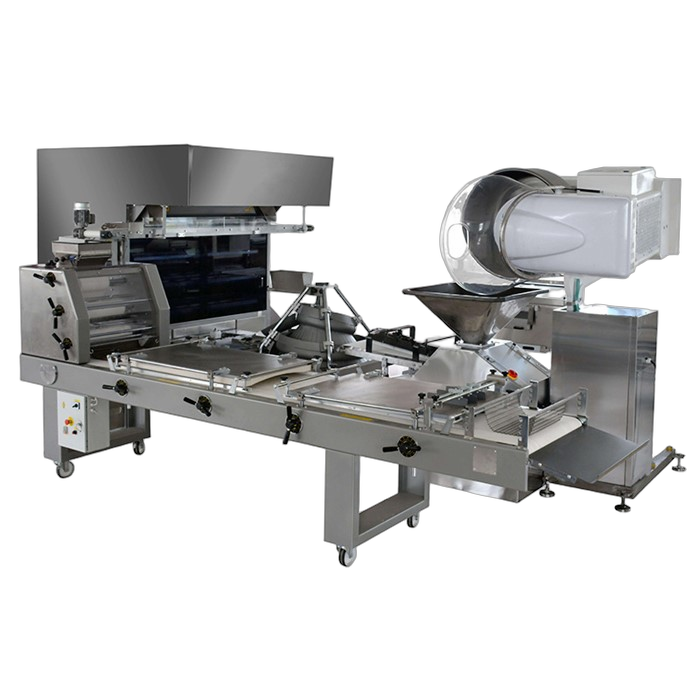
Semi-automatic make-up group | Divider, rounder or intermediate prover, moulder; manual panning and oven loading | Up to about 2,400 pieces/hour from a single-piston divider | A$50,000 to A$150,000 |
Automated make-up line | Dough feeding, divider, rounder, intermediate prover, moulder, automatic panning, recipe control | Depends heavily on piece weight; ask for the rate at yours | Several hundred thousand dollars for European brands |
Complete automated plant | Ingredient handling, mixing, make-up, final prover, tunnel oven, depanning, cooling, slicing, bagging | Thousands of loaves/hour | Multi-million; large projects with buildings exceed A$100 million |
These bands rest on published reference points rather than a single price list:
Listings on the IndustrySearch category page sit between $50,000 and $300,000.
A Spanish semi-automatic group (divider, intermediate prover, moulder) is advertised at US$46,020, about A$65,000, excluding transport, with an output of up to 2,400 pieces per hour.
A Chinese supplier lists a default sheeting, filling and cutting configuration at US$25,000 (about A$35,500), with the price changing as stations are added.
A complete Rondo dough processing line built in 2011 cost €260,000 new, about A$420,000 at October 2026 exchange rates. This is a historical purchase price, not a current quote.
At the top end, Tip Top's new Canning Vale line in WA opened in February 2026 as a $130 million investment producing up to 8,350 loaves per hour. That figure covers a whole factory project, so it shows the scale of a major plant rather than a typical line price.
What pushes the price up or down
Dough type: high-hydration artisan doughs need gentle sheeting systems rather than piston dividers. Rondo's ASTec line, for example, is rated for doughs above 80% water content, and that capability costs more.
Weight range and accuracy: a wide piece-weight range and tight scaling tolerance add cost but cut dough giveaway every shift.
Rows and belt width: multi-row dividers and wider belts raise output without raising speed, and raise the price with it.
Changeovers: each extra product family means tooling, moulds or pan sizes. Count the products you will run in a week, not the ones you might.
Hygienic design: open frames, tool-free belt removal and washdown-rated components cost more but make it easier to meet Food Standards Code Standard 3.2.3, which requires equipment to be easily and effectively cleaned.
Oven and fuel: gas tunnel ovens, thermal-oil ovens and electric deck ovens differ widely in price, installation and approvals.
Local support: a distributor holding parts and technicians in Australia charges more than a factory-direct quote. That margin buys response time when a belt fails at 3 am.
What a line costs landed and installed: a worked example
Australia charges customs duty on the customs value (broadly the price at the export port) and import GST on the value of the taxable importation, which adds duty, international freight and insurance. For an illustrative automated make-up line quoted at €150,000 FOB (your duty, freight and exchange rate will differ):
Cost line | Basis | Amount (A$) |
|---|---|---|
Customs value | €150,000 at about A$1.62 per euro | 243,000 |
Customs duty | 5% general rate for most bakery machinery | 12,150 |
International freight and insurance | Illustrative assumption; get a forwarder's quote | 15,000 |
Import GST | 10% of A$270,150 | 27,015 |
Landed cost at the port | 297,165 |
If your business is registered for GST, the A$27,015 is claimable as an input tax credit, and businesses in the deferred GST scheme pay it through their BAS rather than at the border. Net of GST, the line lands at A$270,150.
The duty line is worth checking item by item. Most bakery machinery falls under tariff subheading 8438.10.90 at a 5% general rate, but bakery ovens are classified separately. A free trade agreement can lower the rate if the goods qualify and you hold proof of origin. A Tariff Concession Order can make an item duty-free where no substitutable Australian product is made, and Australian bakeries have applied for TCOs on equipment such as croissant production lines.
The landed figure still excludes the site costs that often surprise first-time buyers:
local cartage, cranes and rigging
mechanical installation and the supplier's technicians, including travel and accommodation
three-phase power circuits, switchboard upgrades and compressed air
gas supply sizing and Type B approval for industrial gas ovens
drainage, floor works and ventilation
commissioning trials with your dough, staff training and an opening spare parts kit
Ask every supplier to price each of these as a separate line. A quote that bundles them, or omits them, is not comparable with one that itemises them.
New or used?
Used bread lines are widely available from Europe. One marketplace lists complete lines from €12,000 to €120,000 (about A$19,500 to A$195,000), and another quotes €50,000 for basic setups up to €500,000 for high-capacity systems from brands such as König, Rondo, Mecatherm and WP.
The listing price is the start of the cost. Add dismantling, crating and freight, belt, bearing and drive refurbishment, electrical rework for Australian supply, and gas approval for any gas oven: Victoria's definition of a Type B appliance expressly includes second-hand appliances. A used line makes sense when the brand has parts and service support in Australia, you have seen it running, and it suits your dough without major modification.
Tax and finance
The $20,000 instant asset write-off became permanent from 1 July 2026 for businesses with aggregated turnover under $10 million, and the legislation passed in August 2026. The limit applies per asset, so a complete line will almost always exceed it. Assets of $20,000 or more go into the small business pool, depreciated at 15% in the first year and 30% each year after. Where separate machines are bought and used independently, each is assessed as its own asset, so ask your accountant how your purchase should be itemised.
Equipment finance, through a chattel mortgage, hire purchase or lease, spreads the cost over the asset's working life. The useful test is whether monthly repayments sit below the labour and yield savings the line delivers, which [Article 2: How to Size a Bread Production Line] shows how to calculate.
How to get quotes you can compare
Send every supplier the same brief:
Products, piece weights and dough hydration for each
Daily volume and the hours available to produce it
Equipment you are keeping (mixers, ovens, slicers) and its capacity
A site plan with available power, gas, water and compressed air
Your delivery state and site access
A request to price equipment, freight, installation, commissioning, training, spares and warranty as separate lines, with the Incoterm and currency stated
Currency matters on a long project. The Australian dollar rose about 8.5% against the euro between January and October 2026, which changed the AUD cost of a euro-priced line by the same margin. Ask whether the price is fixed in AUD or exposed to the exchange rate until payment.
Compare quotes: Get quotes from Australian bread and bakery production line suppliers on IndustrySearch to compare specifications, installed pricing and support terms side by side.
Frequently asked questions
How much does a small bread production line cost in Australia?
A semi-automatic make-up group for a small wholesale or multi-site retail bakery typically costs A$50,000 to A$150,000 before GST, excluding the oven, installation and freight.
Does a bread production line quote include installation?
Often not, or only partly. Factory-direct quotes frequently exclude installation, rigging, utilities and the technicians' travel. Ask for each as a priced line.
Are Chinese bread production lines much cheaper?
Their list prices are lower: one default configuration is advertised at US$25,000. The gap narrows once you add freight, adaptation to Australian electrical supply, gas approval for ovens and the cost of support from overseas. [Article 3: Importing a Bread Production Line into Australia] covers those checks.
Can I claim the GST on an imported bread line?
Yes, if you are registered for GST and the line is used in your business, the import GST is claimable as an input tax credit.
Can I instantly write off a bread production line?
Only assets under $20,000 qualify. A complete line goes into the small business pool unless individual machines are bought and used as separate assets.