
Key takeaways
Batch, bottom-entry and inline suit different jobs: batch mixers are flexible across vessels; bottom-entry heads work at low fill levels; inline mixers behave like centrifugal pumps and suit recirculation, continuous processing and powder induction.
Viscosity sets the limit: Ross puts the practical limit for its single-shaft rotor-stator mixers at around 10,000 to 20,000 cP. Other manufacturers' figures differ, so ask each supplier for theirs. Above that range, pair the mixer with a low-speed anchor agitator or use a multi-shaft or planetary mixer.
Stator heads matter as much as the motor: disintegrating, slotted and fine screen heads trade throughput against the particle and droplet size they typically produce, with results depending on the formulation.
Powder induction changes the choice: if your product relies on hard-to-wet powders, an inline mixer with a powder induction system is often the better fit.
Powders need a different machine: high shear granulators wet-granulate powders with an impeller and chopper, and are a separate purchase from liquid high shear mixers.
High shear mixers dissolve powders, make emulsions, break down agglomerates and reduce particle size in liquids. Choosing between batch, bottom-entry and inline designs comes down to five questions: what the mixer has to achieve, the viscosity range, batch size or flow rate, how powders enter the liquid, and how the product is cleaned out. This guide works through each so you can brief suppliers on a like-for-like basis.
How a rotor-stator mixer works, in brief
A high-speed rotor turns inside a stationary stator with a close clearance. As the rotor blades pass the stator openings, they mechanically shear particles and droplets and expel material at high velocity into the surrounding mix. Rotor tip speed (rotor diameter times rotational speed) is one of the variables suppliers use to compare and scale up mixers, alongside rotor-stator geometry, energy input, formulation and processing time. Ross describes typical rotor-stator tip speeds of about 15 to 20 m/s, with ultra-high shear designs around 56 m/s. For buying purposes, the practical point is to record the settings used in any trial so the production unit can reproduce them.
Mixer types compared
Type | How it works | Best for | Watch-outs |
|---|---|---|---|
Batch (top-entry) rotor-stator | Mixing head lowered into the vessel on a stand or fixed mount | Emulsions, powder dissolution and dispersions in batches; moving between vessels | Needs enough liquid over the head; limited bulk flow in large or viscous batches |
Bottom-entry rotor-stator | Head mounted through the vessel base | Low fill levels, recirculating through the head as the tank empties | Requires a vessel built or modified for it; seal exposure under liquid |
Inline rotor-stator | Product flows through a mixing chamber, like a centrifugal pump | Recirculation loops, continuous processing, large batches, more controlled shear exposure | Usually needs gravity or pumped feed; uniformity depends on flow rate, number of passes and system design |
Inline powder induction mixer | Draws powder into liquid under vacuum at the head | Dust-free incorporation of gums, thickeners and powders that clump | Powder must flow; check maximum solids loading |
Vacuum homogeniser emulsifier | High shear head in a jacketed vessel under vacuum, often with a scraping agitator | Creams, lotions, ointments and pastes free of air | Larger investment; a complete system rather than a mixer |
High speed disperser | Saw-tooth disc at high speed, no stator | Pigments and solids into paints, inks and coatings | Less intense shear than a rotor-stator |
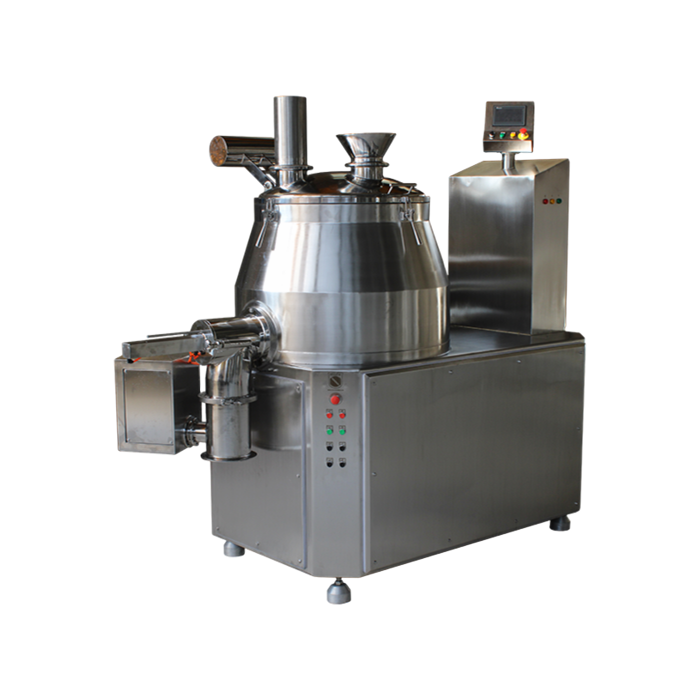
High shear granulator | Impeller and chopper in a bowl wet-granulate powders | Tablet granulation in pharma, nutraceuticals and chemicals | A solids process, not a liquid mixer |
Examples on IndustrySearch show the range: Mixquip's Series 560 is a bottom-entry tank emulsifier and its Series 650 an industrial batch mixer; I.B. Engineering's mixing stations mount on different vessels or a transportable stand; FluidPro's dispersion mixers run at high RPM to incorporate solids; and Tetra Pak lists a batch high shear mixer for ingredient mixing. The Freund, PHARMX and Coperion listings on the same page are high shear granulators, which belong to the High Shear Granulator & Mixer category.
Stator heads and what they do
Disintegrating head: larger openings, typically used for breaking down solids and gels at high throughput.
Slotted head: a general-purpose balance of shear and flow, commonly used for emulsions and dispersions.
Fine screen or square-hole screen: typically used where finer droplet or particle size is wanted, at lower throughput. Results depend on the formulation and processing conditions, not the head alone.
Ask suppliers which head they would use for your product, and trial more than one. Many mixers accept interchangeable heads.
Matching the mixer to viscosity and batch size
Viscosity | Typical approach (Ross guidance; confirm with your supplier) |
|---|---|
Water-thin to about 10,000 to 20,000 cP | Single-shaft batch or inline rotor-stator mixer |
Moderate to high | Rotor-stator or disperser combined with a low-speed anchor agitator for bulk flow |
About 100,000 to 2 million cP | Hybrid planetary or multi-shaft mixers |
For batch size, match the head and motor to the working volume, not the vessel's total capacity. Laboratory units such as the Ross HSM-100LCI-T cover about 1.1 to 15 L, which suits development batches before you scale up.
Powder induction: avoid fish-eyes and dust
Powders such as gums, starches and thickeners clump when added too fast to the surface of a batch. Inline powder induction systems, such as Silverson's Flashmix or Ross's SLIM (solids/liquid injection manifold), draw powder directly into the high shear zone. That cuts dusting and lumps. If your product relies on hard-to-wet powders, ask suppliers to demonstrate induction with your ingredients.
Scale-up and trials
Trial your own formulation before you buy. Ross, for example, runs a test and development centre and a trial rental program; ask every supplier whether they offer a trial. Record tip speed, head type, time and temperature at trial scale, and ask the supplier how the production unit will reproduce them.
Questions to ask every supplier
What tip speed, head and run time do you recommend for our product, and why?
What viscosity range will this mixer handle, and at what point do we need an agitator?
How will powders be added, and what is the maximum solids loading?
Which seals are fitted, and what spare parts are stocked in Australia?
Can we trial our formulation on this model?
Compare suppliers: request quotes from high shear mixer suppliers on IndustrySearch with your product, viscosity and batch size. For budgets, see [Article 1: High Shear Mixer Prices in Australia]; for food, pharmaceutical, cosmetic and hazardous-area specifications, see [Article 3: How to Choose a High Shear Mixer for Food, Pharmaceutical, Cosmetic and Chemical Production].
Frequently asked questions
What is the difference between a high shear mixer and a homogeniser?
The terms overlap. Rotor-stator mixers are often sold as homogenisers; high-pressure homogenisers are a different technology that forces product through a valve at high pressure for very fine emulsions.
Inline or batch: which high shear mixer is better?
Batch mixers are flexible and easy to move between vessels. Inline mixers give more controlled shear exposure, suit recirculation and continuous processing, and some can be configured for powder induction.
What viscosity can a high shear mixer handle?
Ross puts the practical limit for its single-shaft rotor-stator mixers at around 10,000 to 20,000 cP. Other manufacturers quote different limits, so confirm with your supplier. Beyond that range, combine the mixer with an anchor agitator or use a multi-shaft mixer.
Does a faster mixer give a finer emulsion?
Not on its own. Tip speed is one factor; rotor-stator geometry, energy input, formulation and processing time also determine the result, which is why suppliers recommend trials on your product.
Is a high shear granulator the same as a high shear mixer?
No. A granulator wet-granulates powders with an impeller and chopper, mainly for tablets. A high shear mixer processes liquids.